Introductory Materials: Effective Approaches to Vegetable Gardening
These short introductory resources can help you get a greater understanding of how to successfully grow organic food in small spaces. Much of the information is universal, but should be adapted to your particular scale or situation. For example, if you are growing in a preschool environment, bed size and materials would differ from someone working on installing a community garden. Please keep this in mind and adapt the methods to your needs. Click here for more information on using these methods in different garden settings, schools and institutions. (This will take you to the Healthy Community Food Systems website)
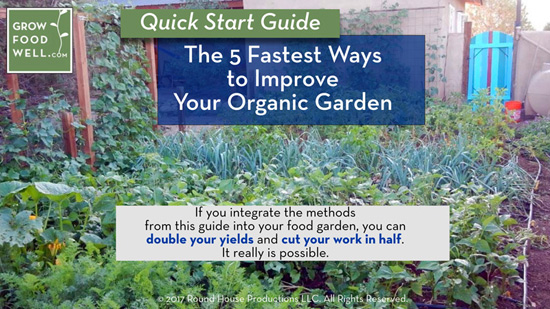
5 Fastest Ways to Improve an Organic Garden (PDF)
Tom Bartels here with some free materials to help you improve your food growing efforts. This Quick Start Guide will show you the 5 Fastest Ways to Improve your Organic Garden. It’s a (46 page) PDF file that you can download free using the button below the photo. Once you look through it you will get a feel for how I approach the many faceted subject of organic food gardening. These methods will help you increase your yields while decreasing your labor.
NOTE: This is a 14Mb downloadable PDF file. (46 pages) Best to right-click and “download as” – then save to your computer and open with Adobe Acrobat or Adobe Reader. Much faster method than viewing in web browser.
[button link=”https://s3.amazonaws.com/gfwvideos42014/5FastestWays.pdf”]Download Quick Start Guide (14Mb) [/button]
How to Reduce Weeds by Design Using Organic Methods {10 min video}
Building Garden Beds
Garden Size and Borders
Garden Size and Borders Transcript PDF
Raised Bed Style (Framed vs Un-framed)
Raised Bed Style Transcript PDF
How to Build a 4×8′ Raised Bed
Framed Raised Beds Transcript PDF
Watering the Garden:
Watering the Garden Transcript PDF
Growing in Garden Beds
Annual Bed Prep (video)
Annual Bed Prep Transcript PDF
Compost Basics (video)
Compost Piles & Bins Transcript PDF
Reducing Pests in the Garden (video)
Creating Living Soil (video)
Finding Your Frost Dates:
Knowing the average frost dates for your area is an important tool for any organic gardener. Whether you are growing in raised beds, vegetables in pots, or have a larger multi-bed vegetable garden, these dates are critical to know for optimum planting times.
Choose your State from the list below.
This will bring up a list of frost dates broken down by town in your state. Find your town and look at the frost dates. If your particular town isn’t listed, look for the town that is nearest to you and shares your general climate and altitude.
Now, we get into How to read the Frost Date chart:
Reading the “Freeze/frost Occurrence Data” that comes up for each state is a bit non‐intuitive, so keep these tips in mind, and remember that you only need to do this once, then write down your first and last frost dates.
-‐Under Threshold, the first vertical column, use the 32F row data.
-‐Under the Spring Date, and Fall Date columns, use the ‘50% probability level’ data.
Now cross reference the two. (Find the number where that column and row cross.)
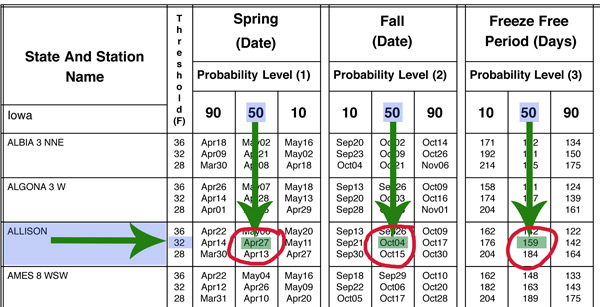
In the illustration above we see that for the town of Allison, at a 50% probability rate of a 32 degree freeze happens on April 27th and Oct. 4th. This creates (roughly) a 159 day growing season. These are the the key numbers.
You will then have one date in the spring that is your ‘Last Freeze’
And a date in the Fall that is your ‘First Freeze’
The days between these two dates equal the length of your growing season between freezes.
The dates you are looking for are just guidelines. There are lots of other variables across the varied landscape we all grow in. But it’s good to know your general frost free growing season dates for your area and these charts should provide you with your dates.
Last Frost in Spring– First Frost in Autumn– Growing Season Length
Now go write those two dates, and season length down. Keep them. They relate to your particular growing conditions at your home garden. You will then use them to plan your custom planting calendar. If you want to get the Free Custom Planting software, see below the State chart down this page.
Choose Your State
Alabama
Alaska
Arizona
Arkansas
California
Colorado
Connecticut
Delaware
Florida
Georgia
Hawaii
Idaho
Illinois
Indiana
Iowa
Kansas
Kentucky
Louisiana
Maine
Maryland
Massachusetts
Michigan
Minnesota
Mississippi
Missouri
Montana
Nebraska
Nevada
New Hampshire
New Jersey
New Mexico
New York
North Carolina
North Dakota
Ohio
Oklahoma
Oregon
Pennsylvania
Rhode Island
South Carolina
South Dakota
Tennessee
Texas
Utah
Vermont
Virginia
Washington
West Virginia
Wisconsin
Wyoming
After you find your Frost Dates, Download the Customizable Planting Chart: (Excel)
To Download the Custom Planting Chart, simply click on the download link below the video and open in an Excel application. Watch the video for the steps to input the Frost Dates you just got for your area.
(If you don’t have Excel, search for a free trial, you only need to print it once!)