Directions
Tom Bartels here with info to help you prepare for growing some food! One of the first tasks, if you haven’t done so already is getting the “Frost Dates” for your particular area. So if you take a couple minutes here to access them and write them down. I’ve even provided you with a template at the bottom of this page that you can print out and keep in your files. You only need to find these dates once, and they help immensely in knowing with certainty when to plant seeds and seedlings during your growing season.
Use the three steps on this page to get:
Your FROST DATES
Your CUSTOM PLANTING SCHEDULE
Your “HARDINESS ZONE”
STEP ONE- How to find your FROST DATES
Knowing the average frost dates for your area is a bit of a “black art” but an important tool for any organic gardener. Whether you are growing in raised beds, vegetables in pots, or have a larger multi-bed vegetable garden, these dates are critical to know for optimum planting times. They are based on the average temperature history in your particular area. This is the easiest way to get them:
Scroll down this page and choose your state from the U.S. STATE LIST below. This will bring up a list of frost dates broken down by town in your state. Then follow these directions to get your dates:
Find your town and look at the frost dates. If your particular town isn’t listed, look for the town that is nearest to you and shares your general climate and altitude.
Now, we get into How to read the Frost Date chart:
Reading the “Freeze/frost Occurrence Data” that comes up for each state is a bit non‐intuitive, so keep these tips in mind, and remember that you only need to do this once, then write down your first and last frost dates.
-‐Under Threshold, the first vertical column, use the 32F row data.
-‐Under the Spring Date, and Fall Date columns, use the ‘50% probability level’ data.
Now cross reference the two. (Find the number where that column and row cross.)
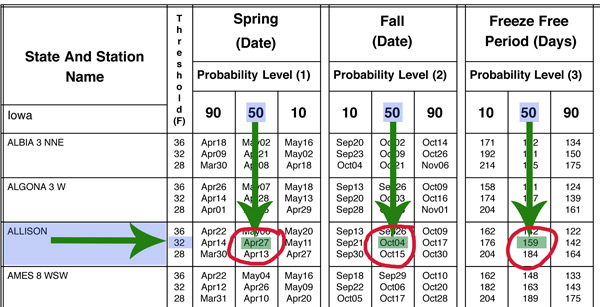
In the illustration above we see that for the town of Allison, at a 50% probability rate of a 32 degree freeze happens on April 27th and Oct. 4th. This creates (roughly) a 159 day growing season. These are the the key numbers.
You will then have one date in the spring that is your ‘Last Freeze’
And a date in the Fall that is your ‘First Freeze’
The days between these two dates equal the length of your growing season between freezes.
The dates you are looking for are just guidelines. There are lots of other variables across the varied landscape we all grow in. But it’s good to know your general frost free growing season dates for your area and these charts should provide you with your dates.
Last Frost in Spring– First Frost in Autumn– Growing Season Length
Now go write those two dates, and season length down. Keep them. They relate to your particular growing conditions at your home garden. You will then use them to plan your planting calendar.
If you would like help understanding how that works, look below for the video explaining the steps.
Alabama
Alaska
Arizona
Arkansas
California
Colorado
Connecticut
Delaware
Florida
Georgia
Hawaii
Idaho
Illinois
Indiana
Iowa
Kansas
Kentucky
Louisiana
Maine
Maryland
Massachusetts
Michigan
Minnesota
Mississippi
Missouri
Montana
Nebraska
Nevada
New Hampshire
New Jersey
New Mexico
New York
North Carolina
North Dakota
Ohio
Oklahoma
Oregon
Pennsylvania
Rhode Island
South Carolina
South Dakota
Tennessee
Texas
Utah
Vermont
Virginia
Washington
West Virginia
Wisconsin
Wyoming
STEP TWO – How to Download and Use the Custom Planting Chart
To Download the Custom Planting Chart, simply click on the download link below the video and open in an Excel application. Watch the video for the steps to input the Frost Dates you just got for your area.
(If you don’t have Excel, search for a free trial, you only need to print it once!)
How to use the Custom Planting Chart
https://s3.amazonaws.com/gfwvideos42014/plantingchartexcel2016.mp4
Links:
STEP THREE – Link to the USDA Plant Hardiness Zone Map
Click here to find your “Hardiness Zone”
This map will get you the Hardiness Zone that is specific to your area. You can search the map by clicking on your state, or, more specifically, put your zip code into the search box on the upper part of the page in this link and search by zip code.
They write down your zone for future reference. It will be something like: Zone 6b for instance.
Then, when you order vegetable seeds for your garden, you will look for varieties that are rated to grow well in your climate conditions.
Documents for you to Download and Print:
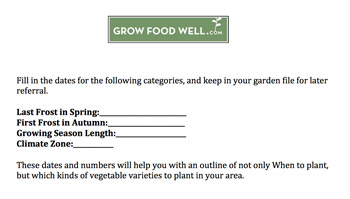
Click on the image below to Download and print the PDF document, fill in your dates, and keep on file.
Then Download and Print the handy plant spacing list below!
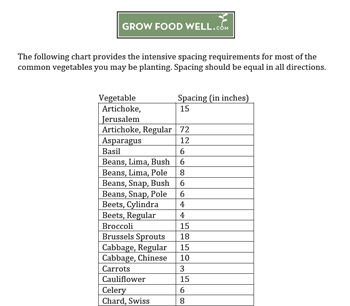
Click on the Vegetable Spacing Chart image below to download it and print for future reference. It will show you the intensive spacing needs of various vegetables.